
Verdeindex Edition 21
By Oscar Petterson Fuentes
Introduction:
This edition explores a central question in climate governance: what determines whether environmental progress holds or unravels? From open-access air quality data and AI-powered fact-checking to regulatory rollback and large-scale conservation policy, the thread running through each story is the role of evidence, incentives and institutional design in shaping outcomes.
Oscar Petterson Fuentes
Non-profit: OpenAQ
This edition’s non-profit, OpenAQ , headed by Chris Hagerbaumer, tackles air pollution, but not in the way you might expect. While this newsletter has often focused on conservation-driven organisations, OpenAQ focuses on something more structural: data.
OpenAQ aggregates open air quality data from around the world into a single open-access platform. The data covers key pollutants including nitrogen and sulphur oxides, ground-level ozone, and particulate matter. These pollutants are now the second leading global risk factor for death and the leading environmental contributor, responsible for more than 8 million deaths in 2021. Clean air is a human right, yet 99% of us are breathing polluted air.
OpenAQ aims to solve this by democratising air pollution data and enabling citizens, researchers and policymakers to use evidence to campaign for change. This is a crucial intervention. Data often comes with high barriers to entry, whether through paywalls or technical complexity. By centralising and standardising air quality data, OpenAQ lowers those barriers and strengthens evidence-based advocacy.
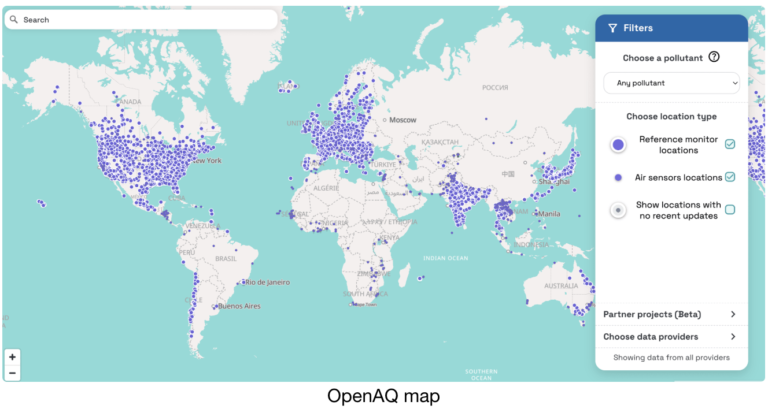
The organisation also makes pollution visible. Its open-source software powers tools such as the Breathe Mongolia Clean Air Coalition, which has an interactive air pollution map, making it easy for the public to visualise pollution in their areas and from there campaign for change. The software’s replicability enables the data to travel, multiplying its impact across platforms and geographies.
Open data is also increasingly important for scientific research. As climate research funding faces political pressure from the Trump administration, access to reliable, free datasets becomes even more valuable. That said, access does not automatically equal usability. Interpreting large datasets still requires analytical skills, which can itself create a new kind of barrier. A barrier that concentrates the information amongst those who have the technical capacity, rather than where it could have the greatest impact. OpenAQ thankfully recognises this and has made it a strategic priority to equip users with the tools and training needed to access and understand the data effectively.
When that bridge is built, OpenAQ achieves something powerful: it turns invisible pollution into measurable evidence, empowering everyone from local activists to global researchers for free. This unique accessibility defines OpenAQ’s role as a quiet but critical player in the climate and public health space.
Website: https://openaq.org/
Breathe Mongolia: https://www.breathemongolia.org/en
Tech start-up: ClimaVAR
Climate misinformation has been an Achilles heel of the climate movement for years. As public discourse becomes increasingly shaped by social media, misinterpretation and deliberate falsehoods can travel faster than scientific consensus. In that environment, evidence often struggles to compete.
This edition’s tech start-up, ClimaVAR, aims to address that gap. Borrowing from football’s Video Assistant Referee system, ClimaVAR reviews contested climate claims and delivers clear, science-based verdicts on climate-related content.
Developed by the University of Exeter’s Nature and Climate Impact Team and unveiled at Davos at the end of January, the technology operates through an AI detection model trained on scientifically curated datasets rather than generic large language models. Each verdict is accompanied by an explanation, showing why a claim was flagged and linking directly to verified scientific sources. The tool is also designed for social media, with decisions shareable as cards, reels, or live commentary.
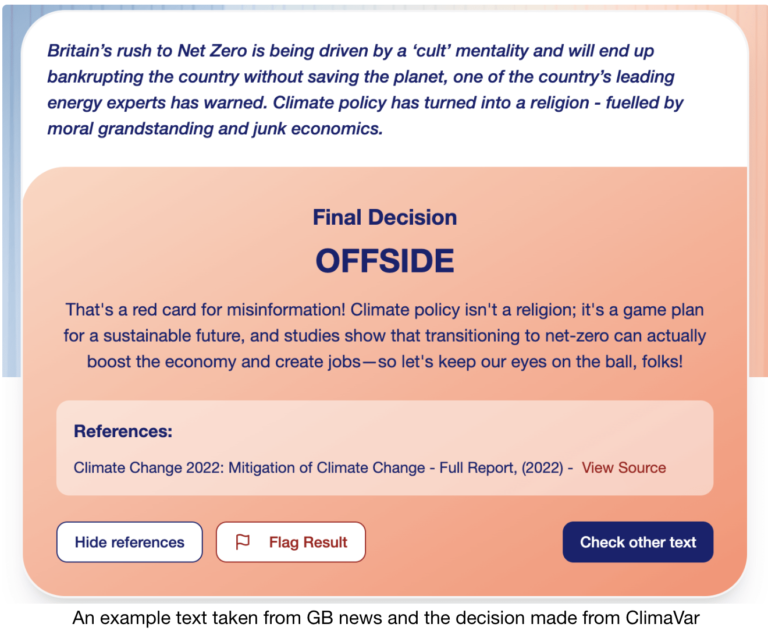
ClimaVAR is still in beta testing, but its early accuracy, clarity and accessibility highlight its potential. The ability to operate in multiple languages adds further scope for scale. If adopted widely, the platform could make climate misinformation, whether from politicians, fabricated experts or online commentators, easier to scrutinise in real time. Rather than searching through dense reports, users can check claims quickly and transparently.
Whether ClimaVAR can meaningfully shift the tone of climate discourse remains to be seen. But if effective, it could help refocus debate on evidence, allowing attention to move from questioning the science toward accelerating solutions.
Website: https://climavar.com/
Challenge: Dismantling the Endangerment Finding
Donald Trump has been a recurring feature of the challenge section across these newsletters over the past year. While I try to bring new topics into focus, the regulatory shifts under his administration continue to have material implications for sustainability and environmental governance.
Last week, Trump announced the termination of the “endangerment finding”, which determined that greenhouse gases threaten public health and welfare and should therefore be regulated. This finding, underpinned by years of scientific evidence, formed the legal foundation for many US climate policies, including regulations on emissions from power plants and the promotion of the electric vehicle industry. The implications of this deregulation on the latter create strategic challenges for American automakers, potentially encouraging the production of higher-emission vehicles for the domestic market that may struggle to compete in jurisdictions with tightening standards.

The administration has stated that this rollback will save $1.3tn for American households. However, this estimate does not account for the economic and public health costs associated with increased greenhouse gas emissions, including higher air pollution, more frequent and intense wildfires, and the accelerated formation of ground-level ozone. The Environmental Defence Fund estimates that repealing the endangerment finding could result in tens of thousands of additional premature deaths by mid-century. The distributional impacts of such policy shifts are also uneven, with lower-income communities often disproportionately exposed to environmental and health risks.
The termination of the endangerment finding is likely to face substantial legal challenge at the federal level, with Connecticut and California already pledging to sue the administration. While political cycles are temporary, regulatory decisions of this scale can have long-lasting consequences. Continued litigation and policy opposition will therefore be critical, not only for future American generations, but for the global trajectory of climate governance.
Articles on the topic:
The Economist: How dangerous is Donald Trump’s “endangerment” decision?
The Gaurdian: Trump’s repeal of landmark Obama-era climate rule: four key takeaways
Hope: Restoring the Yangtze
China has a certain duality when it comes to its environmental impact. On one hand, it remains the world’s largest emitter of greenhouse gases. On the other hand, it has the highest installed capacity of renewable energy globally. This tension between the scale of damage and the scale of action is further illustrated by the Ten-Year Fishing Ban in the Yangtze River.
The 2021 Yangtze River Protection Law formalised a ten-year ban on fishing, running until 2030 and covering the length of China’s longest river. To put the scale into perspective, around 30% of China’s population lives within the Yangtze River drainage basin, and the 11 provinces and municipalities that form the Yangtze River Economic Belt generate roughly 47% of the national GDP.
The recovery of fish populations since the ban highlights an unavoidable truth: when it comes to ecological restoration, incrementalism often falls short. The Yangtze ban provides a rare example of large-scale intervention, and aligns with a broader global trend toward no-fishing zones and marine protected areas.
Yet boldness carries trade-offs. Scrapping over 100,000 fishing boats and resettling more than 200,000 fishers required an estimated $3 billion support package. Such a sweeping intervention may be easier to execute in a centralised political system than in pluralistic democracies, where compensation design, stakeholder resistance, and legal contestation can slow implementation.

The policy’s long-term success, however, will depend less on its announcement and more on its incentive structure. Game-theory modelling of the ban suggests that increasing the likelihood of detection deters illegal fishing more effectively than simply raising penalties. It also shows that improving the efficiency of livelihood support, ensuring funds genuinely translate into viable alternative income, matters more than increasing the size of subsidies.
Sustaining these incentives will be crucial. If maintained, the Yangtze could become one of the most significant conservation case studies of the decade. Whether similar policies could gain traction in Western democracies remains an open question, not of ecological necessity, but of political feasibility.
Articles on the topic:
Live Science: China banned all fishing to save the Yangtze River. This ‘nuclear’ option appears to be working
Inside Climate News: Five Years Into a Fishing Ban, the Yangtze River Is Teeming With Life
Image of the week:

Alexis Rockman
Cascade, 2015
“The Cacade is an atwork from the The Great Lakes Cycle, which explores the past, present, and future of North America’s Great Lakes–one of the world’s most emblematic and ecologically significant ecosystems.
This multifaceted project was initiated in 2013 when artist Alexis Rockman embarked on a research tour of the Great Lakes region. The centerpiece of the exhibition is a suite of five mural-sized paintings which explore separate themes that emerged during Rockman’s travels. These are accompanied by several large-scale watercolors and field drawings–monochromatic animal and plant studies made from site-sourced organic material such as mud, sand, coal, and leaves.
One of the world’s great natural treasures, the Great Lakes—Erie, Huron, Ontario, Michigan, and Superior—form an interconnected system that is among the most beautiful, economically important, and ecologically complex regions on the planet. The Great Lakes, which hold over 20% of the world’s fresh water, contain some of the most precious resources for the future of humankind and life on earth. Rockman’s series celebrates the natural majesty and global importance of the Great Lakes while exploring how they are threatened by factors including climate change, globalization, invasive species, mass agriculture and urban sprawl. While there has been some success in reversing these trends, the exhibition of these dramatic works will serve to inspire wider understanding and draw greater attention to the urgency of these issues.”
Articles you may have missed:
1. UK and California deepen ties on clean energy to boost investment
2. The greening of career education: US students learn new skills as climate crisis intensifies
3. ‘It makes no sense’: the battle over plans for a windfarm by the Yorkshire Dales
4. ‘Akin to flat Earth or denying gravity’: Experts weigh in on Trump repeal of key climate finding
Thank you for reading!
To sign up to the newsletter, go to www.verdeindex.com
Or follow Verdeindex on LinkedIn at: https://www.linkedin.com/company/verdeindex/