
Verdeindex Edition 20
By Oscar Petterson Fuentes
Introduction:
To start the year, I wanted to focus on where sustainability is being shaped in practice. In this edition of Verdeindex, I explore land restoration models that align ecology and economics, technologies tackling aviation’s hardest emissions, and the role media plays in shaping how climate action is understood and challenged, before closing on signs that pragmatism may finally be shifting in favour of the transition. I hope you enjoy reading, and I wish you a happy 2026.
Oscar Petterson Fuentes
Non-profit: Commonland
Founded in 2013 by ecologist Willem Ferwerda, Commonland provides a compelling business case for sustainable land management that benefits communities for generations to come. With an ambition to restore 100 million hectares of degraded land by 2040, the organisation is a powerful example of how long-term ecological ambition can be paired with pragmatic economic thinking.
At the core of Commonland’s approach is the belief that ecology should drive the economy. From this principle emerged the 4 Returns Framework, which offers a practical way to generate returns for nature, people, communities, and businesses simultaneously. Rather than treating environmental restoration as a cost, the framework reframes it as the foundation for resilient local economies.
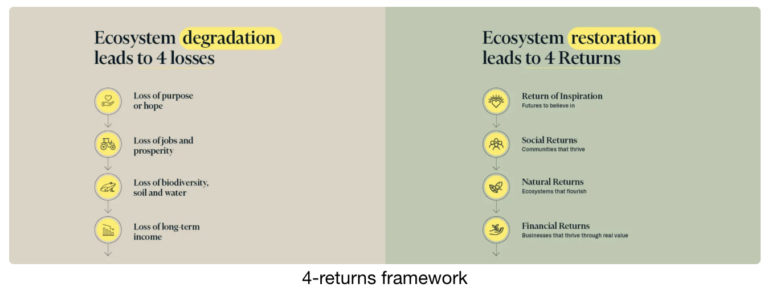
While deliberately broad, the framework is designed to be adapted to local contexts. This flexibility is reflected in Commonland’s work across more than 20 countries. Between 2013 and 2023, the organisation supported over 44,000 hectares of direct land restoration, which in 2022 alone sequestered approximately 78,000 tonnes of carbon dioxide.
These real-world environmental impacts, coupled with the pragmatic economic approach, are illustrated particularly well through their work in Altiplano Estepario, in Andalucía, Spain. This region, which covers over 1,000,000 hectares, has seen a great reduction in biodiversity due to desertification, extreme climate conditions and unsustainable land management practices.
In response, Commonland partnered with AlVelAl, an ecosystem regeneration association with over 490 members, including 280 farmers. Together, they aim to restore 25,000 hectares of natural corridors to reconnect protected areas, while supporting the transition of more than 600 existing businesses into a new, ecologically grounded economic model.
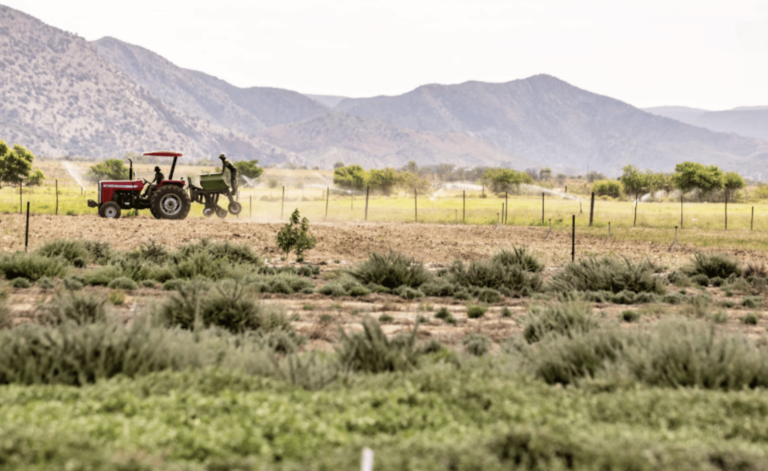
Operating across diverse landscapes worldwide, Commonland demonstrates that economic systems do not need to maximise profit at the expense of the environment. Instead, they can be designed to protect, restore, and strengthen natural systems over the long term. Without this shift, a thriving and resilient future risks remaining a distant aspiration rather than an achievable outcome.
Website: https://commonland.com/
Tech start-up: Metafuels
Recently, one of my courses at university asked me to calculate my carbon footprint. The result genuinely shocked me. Despite being conscious of my environmental impact, I was emitting 160% of the UK average. When I looked closer, the reason was clear: flights accounted for a significant share of my emissions.
Flying remains the most carbon-intensive choice an individual can make. Yet it is deeply embedded in modern life and an increasingly interconnected world. With much of my extended family living abroad, cutting out flying altogether is not a choice I am currently willing to make, and I suspect this is a familiar dilemma for many.
This tension is what makes aviation so difficult to decarbonise. Few alternatives exist that allow people to keep flying while meaningfully reducing emissions, which is why sustainable aviation fuels (SAF) have emerged as one of the only viable levers for change. This edition’s featured tech start-up, Metafuels, co-founded by Saurabh Kapoor, Leigh Hackett and Ulrich Koss, is working at the centre of that challenge.
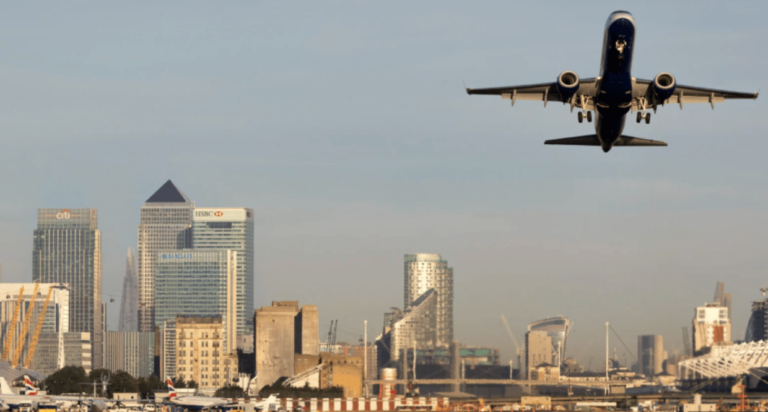
If we want to maintain current flying habits, the scale of the challenge is immense. Globally, around 250 billion litres of fossil jet fuel are used each year. Replacing even a fraction of this requires technologies that can deliver SAF quickly, affordably, and at scale.
Metafuels’ proprietary technology, Aerborew, is designed to meet this challenge. The process begins with green hydrogen, produced via renewable-powered electrolysis, combined with captured carbon dioxide to create green methanol. This methanol is then fed through a proprietary catalytic system that enables an efficient methanol-to-jet fuel conversion while maintaining high carbon conversion.
As costs fall in renewable electrolysis and carbon capture, the technology is designed to scale. Following successful pilot programmes that met key performance indicators, Metafuels is now moving towards large-scale SAF projects across Europe. By the mid-2030s, individual plants are expected to reach production capacities of up to 1,000 tonnes per day, enough to fuel hundreds of thousands of long-haul flights annually, representing a meaningful step towards decarbonising one of the hardest-to-abate sectors.
Website: https://metafuels.ch/
Challenge: Manufacturing Doubt
Climate change is no longer debated in the scientific community, but it is still fiercely contested in the public sphere. That gap is not accidental. It is sustained through disinformation: the deliberate framing of misleading claims in ways that distort public understanding, erode trust in climate policy, and politicise what should be a question of evidence.
When 99% of climate scientists agree on the reality and causes of climate change, the persistence of a polarised debate is not a failure of science. It is a failure of communication and, increasingly, of media responsibility.
A clear example of this can be seen in recent reporting on net zero by The Times. Bob Ward, Policy and Communications Director at the Grantham Research Institute on Climate Change and the Environment at LSE, found that the newspaper had misrepresented findings by the National Energy System Operator (NESO). On the 11th of December, The Times released a headline in the print edition stating that “Net zero plan to cost households £500 a year”, while the online edition was “Scrapping net zero deadline could save households £500 a year.”
This claim of households somehow saving £500 a year was mentioned nowhere in the NESO report. The Times stated that this value was based on official findings about the plan’s cost to the British economy (£14 billion, excluding carbon taxes), which they divided by the number of households. The complete misrepresentation of these findings in the headline of the article makes this particularly damaging.
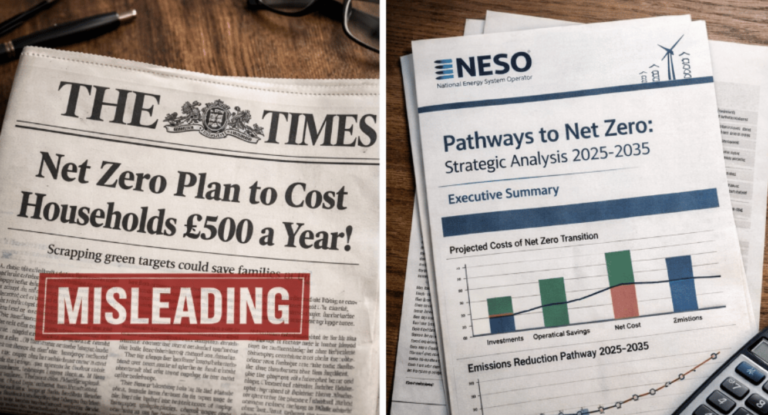
This matters because headlines increasingly become the story. In an attention economy, many readers never move beyond the framing of the claim itself. When a mainstream outlet repeatedly misrepresents net-zero analysis, the result is not healthy scepticism but manufactured doubt. It allows a trend in which objective facts, such as climate change, are questioned by emotion and personal belief. Therefore, disinformation becomes easy. It does not need to make audacious claims that deny climate change outright; it only needs to make climate action feel costly, confusing, or unreasonable.
The example of The Times showcases that if we want a serious public conversation about the transition ahead, media accountability is not optional. When headlines frame sustainability as a cost rather than a necessity, readers have a responsibility to look beyond the claim: check the sources, understand the context, and judge the argument on evidence, not emotion.
Articles on the topic:
Hope: Pragmatism Begins to Shift
We are kicking off this year’s hope section with a reflection on 2025. For the first time on record, wind and solar overtook oil and gas power generation in the EU. Wind and solar supplied 30% of the EU’s electricity in 2025, overtaking fossil fuels, which fell to 29%, for the first time on record. This gap may not seem like much, but the report produced by Ember thinktank said this event was a “major tipping point” and one of strategic importance to the EU.
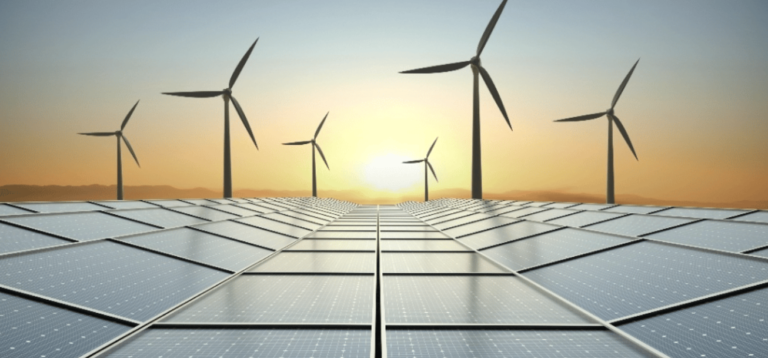
This news comes at a time when geopolitics has pushed energy security to the top of the political agenda. However, instead of fraying and moving back to domestic oil and gas production, countries in the EU have pushed forward with their renewables.
- “Solar alone grew by more than 20% in a single year, proving that clean power can scale faster than any conventional technology”
This growth in renewables can largely be attributed to the fact that these energies make economic sense.
One of the most positive developments of 2025 is that, despite the backlash against ESG, renewables, and even climate science itself, the technologies shaping the future are proving to be the most pragmatic ones. In the twentieth century, a pragmatic approach favoured oil and gas, triggering a profound societal transformation. Today, that same logic is beginning to work in favour of renewables. Within a capitalist system, when pragmatism shifts, rapid and transformative change follows.
Articles on the topic:
The Renewable Energy Institute: Wind and Solar Surpassed Fossil Fuels in EU Power Mix
My Outlook
I reflect on this piece, really questioning what approach to take into 2026. Through my university studies in sustainable development, I am constantly pushed to question whether sustainability is even possible within a capitalist system.
I have battled with this idea, and although it holds a lot of weight, it has become clear to me that the solutions of today can only exist within our current economic system. Waiting for a perfect system risks delaying the progress that is already within reach. This does not mean that we should not think of how an ideal future could look, but right now, we must use our energy, resources, and collective fight to enable the green solutions that exist now to succeed and fight the outdated industries that continue to harm the planet.
A capitalist system anchored in green technologies rather than oil and gas, both born from the same pragmatic logic, fundamentally changes what is possible. Once that shift occurs, aligning the economy with the systemic changes required for real sustainability becomes so much easier. My outlook may change again, but for now, this is the perspective I am choosing to carry forward.
Articles you may have missed:
1. Tech has changed the climate solution game but protecting nature is still priority, experts say
2. Love, fear, anger and hope: how emotions influence climate action
3. Trump can’t be this obsessed with Greenland and deny climate change
4. Our natural world is under threat as never before. What must happen to restore it in 2026?
Thank you for reading!
Follow Verdeindex on LinkedIn at: https://www.linkedin.com/company/verdeindex/