
Before We Go Off-World, We Go Offshore
By Oscar Petterson Fuentes
Introduction
Data centres have become one of the most in-demand infrastructure assets, driven by the rapid growth in computing needs from AI and an increasingly digital society. According to Dell’Oro, worldwide spending on data centres grew by 57% in 2025 and is forecast to pass $1 trillion in 2026.
But the limit on this growth is no longer demand. It is whether the physical world can keep up. The IEA estimates that around 20% of planned data centre projects could be at risk of delay if grid constraints go unaddressed, and building new transmission lines in advanced economies can take four to eight years. In the UK the pressure is particularly acute: NESO shows nearly 59 GW of data centres awaiting connection at transmission level, although it does not expect all of them to connect. Together with tightening planning rules and local opposition, the question for the sector is shifting from how much computing the world wants to where it can actually be built.
The Problem
Data centres are usually described as an energy problem, but the first obstacle is not generation. It is delivery. For a data centre to operate, power has to travel from where it is produced to where it is used, and in Europe that infrastructure is struggling to keep pace. The IEA notes that building new transmission lines in advanced economies can take four to eight years, far slower than the pace at which operators want to expand.
With grids struggling to keep up, governments are beginning to ration access. In Denmark, the state-owned grid operator has paused new connections after requests for large projects, many of them data centres, reached roughly nine times the country’s peak electricity demand, and the government has proposed ranking data centres not tied to critical functions last in the queue. Ireland and Spain are going the other way, opening the grid only on conditions. Ireland now requires large sites to bring their own on-site generation or storage, while Spain’s draft decree, which first proposed that new renewable power cover at least 80% of consumption, now phases that in, reaching 80% for peak hours only by 2032. For developers, the direction of travel is unclear, and the rules are still changing.
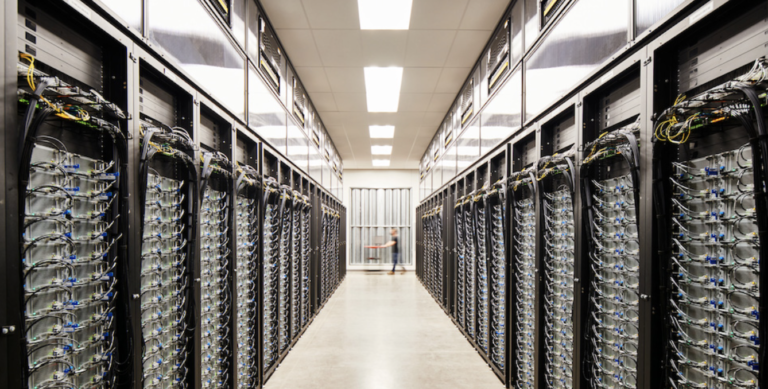
But the grid is not the only constraint. Data centres also face a growing question of acceptance. They take land, power and often water, and the people who live nearby are asking what they get in return. In the UK, the campaign group Foxglove has opposed AWS’s planned Houghton Regis campus in Bedfordshire, asking the government to show there is enough water and power for nearby residents and how emissions will be limited. For communities, the social question of who benefits and the environmental question of what is used are not separate. Both come down to whether a data centre takes more from a place than it seems to give back.
The problem, however, is that these constraints are tightening just as demand accelerates, and investors are noticing. A project that cannot get a grid connection or planning permission cannot be delivered on time, and late delivery is a financial risk, not just an inconvenience. The Financial Times reports that construction delays raise the prospect of tenants, typically Big Tech companies or AI labs, walking away under contract clauses. Alongside higher borrowing costs, that is helping to shake the confidence that releases capital. In the US, where the build-out is largest and AI infrastructure spending is projected to pass $10tn between 2025 and 2032, investors have begun to reprice the risk. If that confidence fades, the effects could reach beyond data centres into stock markets and the wider economy.
On the Ground: Nscale
Nscale is a UK start-up that builds AI infrastructure. Data centres are at the core of its growth strategy, backed by investors including Nvidia, Apollo, Citadel and Hudson Bay Capital through a $3.36bn pre-IPO convertible financing round closed in September. But it has now made headlines for the wrong reasons, with Microsoft, one of its two biggest customers, reportedly pulling out of its flagship UK project.
Microsoft’s involvement came through Nscale’s Loughton campus in Essex. Announced in September 2025 and billed by Nscale and Microsoft as the UK’s largest AI supercomputer, it was due to start with 23,040 of Nvidia’s latest GB300 chips on 50MW of capacity, scalable to 90MW. Then Prime Minister Keir Starmer hailed this as a significant stride to the UK becoming world leaders in AI. On 18 October, it was reported that Microsoft had cancelled its agreement after it emerged that the site was unlikely to have a power supply until after 2030, rather than being connected to the grid this year as planned. Microsoft has not officially commented, and Nscale says its relationship with Microsoft remains strong.
This news deals a blow to Nscale, as Microsoft and Anthropic account for about 85% of Nscale’s contract value, according to its IPO filing, so losing either would hurt. To compound the challenge, the FT reports that Anthropic can walk away from its $45bn deal if Nscale misses financing or delivery timelines for a major project in West Virginia. The FT adds that the site is set to rank among America’s 20 biggest sources of greenhouse gases, and that it has been hit by building issues, local opposition and regulatory scrutiny after run-off from the construction repeatedly flooded nearby neighbourhoods.
Not all of Nscale’s problems appear to be of its own making, and together they show how hard this kind of building is becoming. Data centres at this scale emit greenhouse gases, draw heavily on power and often water, and reshape the land around them, so more and more sites are running into a grid, a regulator or a community. At Loughton it was the grid. In West Virginia it was emissions, flooding and local opposition. As more places add rules and more grids reach their limits, the locations where data centres can be built quickly may be shrinking, and fast delivery is exactly what AI developers need.
The Missing Piece
Across the sector, developers are finding that grid connections, regulation and local opposition are slowing delivery, and some are beginning to ask whether large, grid-connected data centres on land can keep pace with demand. One alternative is to build at sea. Offshore data centres could be cooled by seawater and powered directly by offshore wind, which could ease three pressures at once. They would avoid drawing on scarce fresh water on land, they would take their power at source rather than adding to demand on the grid, and they would be powered by renewable energy.
Offshore wind could benefit too, in two ways. The first is curtailment, where the system operator pays wind farms to switch off because the grid cannot carry their power to where it is needed.
In 2025, around 10 TWh of renewable electricity was wasted this way in Great Britain, almost all of it Scottish wind. Paying curtailed renewables cost £363 million, according to Montel, and by one wider measure, the full cost of managing these constraints, including bringing in other power, reached about £1.5 billion, according to Octopus Energy’s analysis of Elexon data. Either way, the bill ultimately falls on consumers.
This matters to investors as much as to the grid. Today, every new wind farm sends all of its output into the same congested grid, which adds to the bottleneck and makes it more likely that new and existing farms are switched off. These wind farms are paid for the power they deliver, and lenders finance them on the expectation that this income will be steady. Curtailment makes it less certain, and it is a growing cost that regulators and consumers are unlikely to accept forever.
A new project with a data centre on site would have a second customer for its power, so less of its income would depend on a congested grid. That could make it easier to finance. It would also help existing projects. With less new power competing for limited grid space, existing farms could be switched off less often and sell more of what they generate. Over time, a development that lowers the risk for both new and existing projects could mean cheaper finance across the sector, though that depends on the data centres themselves being reliable customers.
The second benefit is for floating wind. Most offshore wind farms today are built on fixed foundations that go straight down to the seabed, which only works in relatively shallow water. Floating turbines sit on platforms anchored in place, so they can be built in much deeper water, but they currently cost far more due to the earlier stage of the technology. That is a problem for countries whose coasts drop away quickly, including those bordering the Celtic Sea and the Mediterranean, because fixed turbines are not an option there and this is represented in the negligible offshore wind industries in countries such as Spain, Italy and Portugal.
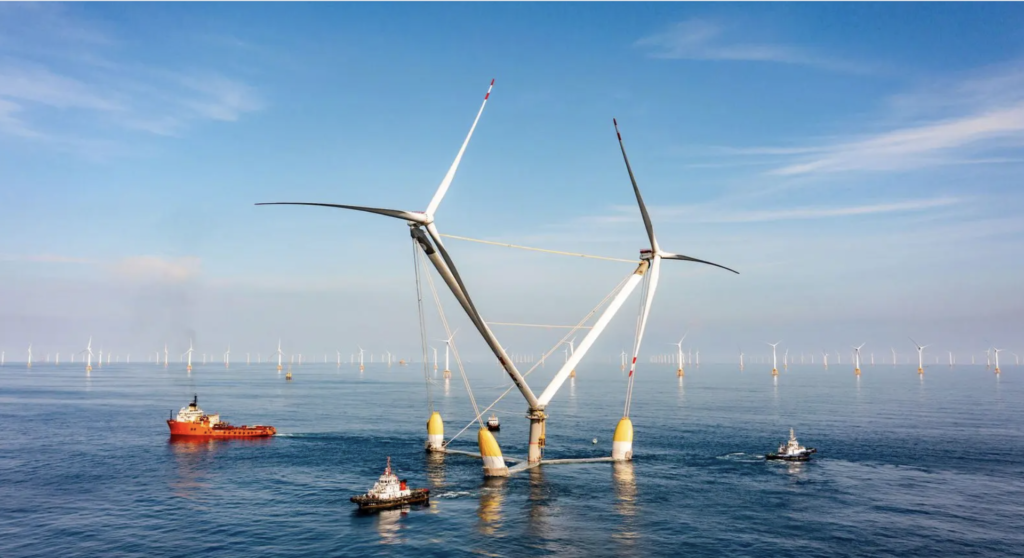
Data centres could help change the maths. A floating platform needs a large surface area to stay stable, and that same space could hold computing capacity. In addition, a second source of income could help close the cost gap with fixed wind, and might be what makes deep-water projects financeable. Mingyang, one of the world’s largest turbine makers, is already studying the idea. Its chief technology officer, Xinyu Zhang, told Recharge that adding data centre capacity would “generate new value” for floating wind and that with it “things might be totally different.” The company is clear that the platform is still pre-commercial and that the idea adds costs of its own. But if it works, regions with deep water that have struggled to build offshore wind could attract investment and gain a source of renewable power when the sun isn’t shining, alongside a place to host the computing the next generation of economies will rely on.
Articles on the topic:
The National: Scotland’s largest offshore wind farm ‘switched off most of the time’
The Guardian: World’s first wind-powered underwater datacentre starts operating in China
Company in Focus: Aikido Technologies
Aikido Technologies offers an interesting offshore data centre solution. Founded in 2022 by Sam Kanner (CEO), Dr. Bingbin Yu (Chief Engineer, Platforms) and James Reeves (Chief Engineer, Wind Turbines), the Californian based start-up has introduced a floating wind platform, which integrates AI-capable computing with offshore wind energy production.
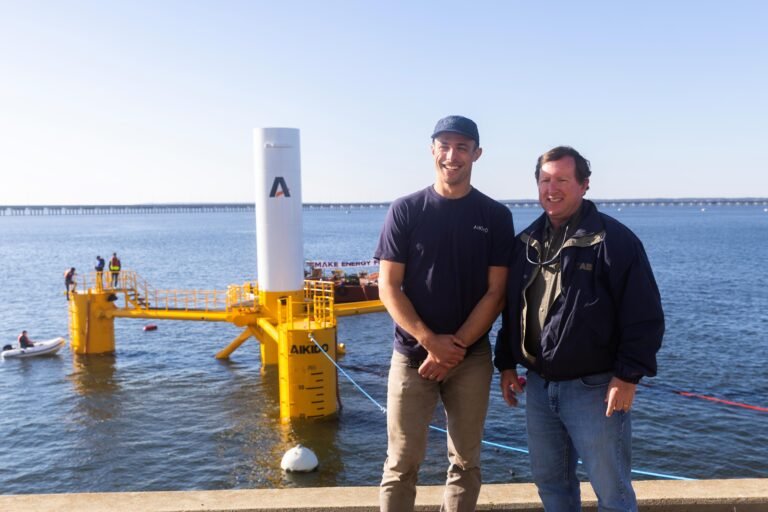
Their flagship product is the AO60DC, which has been designed to support 10 and 12 megawatts of AI computing alongside a wind turbine rated at up to 18MW and includes built-in battery storage. Although the 12MW of computing is much smaller than the 90MW of capacity the Loughton complex would have held, a key idea behind Aikido’s technology is that it is a modular concept, which, according to the company, can be built up to ten times quicker than traditional offshore structures.
The in-built battery storage is also worth noting. It means that these data centres can run mostly on wind and storage, using the grid to top up in seasons with less wind, which is typically in summer, when the grid is rich in solar, so that top-up could come from relatively abundant low-carbon power. The company also mentions how the batteries can be pre-charged ahead of grid stress events. This all contributes to a more intelligent grid, and could help to reduce issues such as curtailment. Additionally, the units can be installed and serviced using vessels already active in offshore wind, which the company says can enable maintenance response times comparable to conventional data centres. However, installation and servicing vessels are already facing pressure to meet demand, due to the significant growth in the offshore wind industry, so wider investment in these industries will be required.
Aikido Technologies offers a great solution on paper, but it is still at the pilot stage, so its cost and investability are unproven. A 100kW prototype is planned off Norway this year. The first commercial unit is not expected until 2028. Monitoring how this progresses will be essential to seeing whether offshore data centres can really take off.
Website: https://www.aikidotechnologies.com/
Verdeindex View
Aikido Technologies is working at the heart of the data centre issue and as Sam Kanner put it "Before we go off-world, we should go offshore." A direct response to the current hype around installing data centres in space, which is even further away from being a viable solution.
For as long as the build-out frenzy continues, developers and investors will look at ideas like this. It can draw on a mature offshore industry for installation and servicing, and it could ease problems facing data centres on land, including the wait for a grid connection and the use of fresh water. However, offshore compute makes sense only if AI demand keeps growing, and the grid keeps lagging behind it.
The biggest risk is timing. The tailwinds behind AI could turn before the first commercial project arrives in 2028, and there are reasons they might. The benefits promised by AI must be weighed against its costs to the environment, to public trust, and the possibility of a misaligned AI system. Right now the guardrails and transparency to manage those risks lag behind the pace of development, and in September the leaders of Anthropic and OpenAI said themselves that it should be paced. If concern rises among the public and governments, investors are likely to price that in, and novel infrastructure like offshore compute is likely to feel it first. That is what makes developments in Aikido’s pilot worth watching.
Sign up to the newsletter
New editions, sent as they're written. No spam, unsubscribe any time.
Sign up →