
The Hidden Risk Behind the Energy Transition
By Oscar Petterson Fuentes
Introduction
I recently attended a webinar hosted by Zurich Resilience Solutions and Recharge, where the discussion centred on how physical climate risk is beginning to reshape renewable and infrastructure assets. My key takeaway was simple: as the Earth’s climate becomes more unstable and unpredictable, it becomes increasingly difficult to ignore how physical risk may affect the longevity and operational viability of renewable energy projects.
Central to this challenge is data, and how physical climate risk can be quantified in a way that supports infrastructure investment and operations. As investors commit billions to the energy transition, understanding how assets may perform under future climate conditions is becoming just as important as understanding how they perform today.
Repath is one company attempting to address this challenge, building software that translates physical climate risk into actionable insights for investors and operators responsible for financing and managing critical infrastructure.
The Problem
Renewable energy infrastructure is, by definition, weather-dependent. That has always been true. What is changing is the weather itself.
Extreme weather events are growing in frequency and intensity, and the consequences for renewable assets are becoming increasingly visible. Component wear is accelerating, and unplanned repair costs are climbing. Investors looking at existing project performance are beginning to notice.
Naturally, investors look to insurance as the safety net. This is where the problem deepens. Traditional insurance was built around discrete damage events: a storm, a flood, a fire. What extreme weather increasingly produces is something different: more frequent downtime, shifting weather patterns and reduced output over time. These operational impacts are not what insurance policies are designed to cover, meaning the safety net investors rely on has a significant gap in it.
Without adequate coverage, investors are left to absorb unpredictable costs themselves. Confidence erodes, and financing becomes harder to secure, highlighting how important resilient and predictable renewable energy infrastructure is to ensure the energy transition.
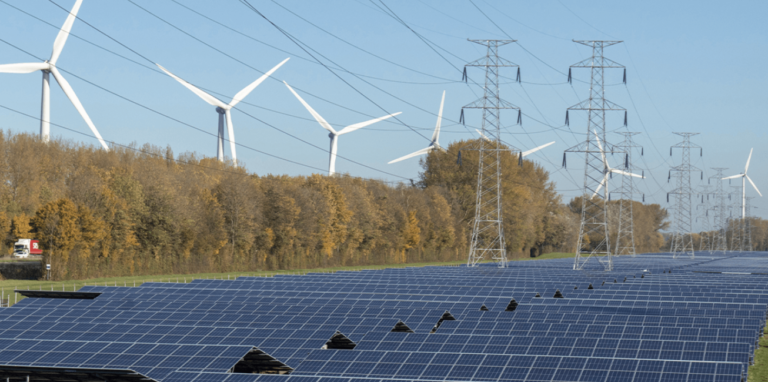
With global renewable power capacity needing to roughly triple by 2030 to stay aligned with climate goals, much of the infrastructure required for the transition has yet to be built. Understanding physical climate risk is, therefore, fast becoming a precondition for getting projects off the ground at all.
On the Ground: India
Electricity demand in India is expected to grow faster than any other major market in the coming years. Coupled with Prime Minister Narendra Modi’s 2030 deadline to vastly expand the country’s renewable capacity, India is uniquely positioned at the centre of the energy transition.
However, the climate is creating its own narrative. A Bloomberg analysis found that India stands out as a major economy where wind speeds have consistently declined since the start of the century, compared to the long-term average. Scientists attribute this to a warmer Indian Ocean, which reduces the temperature and pressure differentials between land and sea, factors that are crucial in creating wind. This is a physical consequence of a changing climate already impacting output and challenging climate-neutral energy forecasts.
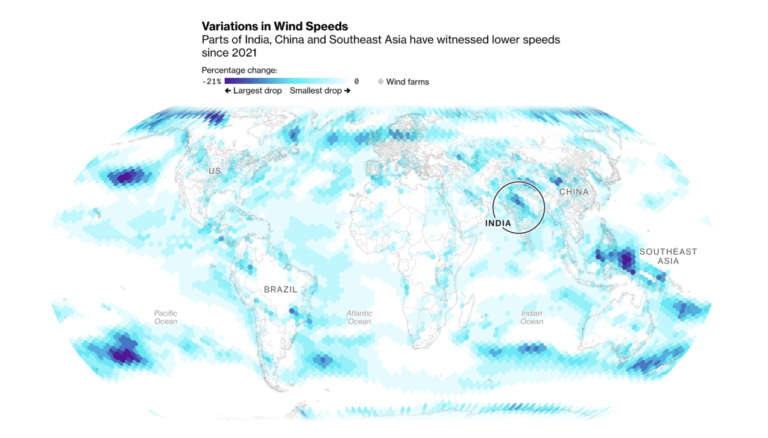
The consequences in financial circles are already being seen. Eversource Capital, one of India’s largest climate-focused asset managers, has begun to prioritise solar energy due to the potential negative impact of weaker speeds. ReNew Energy Global, which operates more than 150 renewable projects across India, has gone further and decreased its forecast for annual profit by a range of almost 10%, citing declining wind speeds.
As a response to investor angst, India’s government is installing at least 13 centres across the country dedicated to monitoring regional renewable energy generation trends, and is promoting projects that include hybrid energy generation, combining wind, solar and storage. The logic is that diversification across energy sources hedges against the failure of one source.
But monitoring trends and promoting hybrid projects takes time, and it requires accurate, forward-looking data on how those resources will continue to shift. As the World Meteorological Organisation’s Roberta Boscolo puts it, “The industry has to look at where to put the assets – not only looking at the past, but also looking at the future.”
Articles on the topic:
Bloomberg: Investors Want to Understand How Wild Weather Threatens Clean Energy
The Missing Piece
Renewable energy is often assumed to be inherently resilient. Clean energy, by definition, addresses the cause of climate change. But as Emmanuel Mtika and Carolyne Pickler reinforced in a recent Recharge and Zurich Resilience Solutions webinar, resilience is far from guaranteed under the umbrella of renewable energy. It is highly variable, and it has to be deliberately built in.
True resilience operates across three interconnected layers.
The first is site selection. Not simply asking whether there is wind or sun today, or historically, but integrating forward-looking climate scenarios into the planning stage to understand what conditions will look like across a project’s lifetime. The second is engineering design, ensuring the technology is suited to the site and the site is suited to the technology. Does a given asset hold up against all plausible future conditions? Getting this right at the design stage dramatically reduces the risk of stranded assets or costly retrofits down the line. The third is operational resilience, once an asset is live, embedding modern predictive maintenance and AI-powered weather monitoring to manage performance in real time.
These three layers are not optional add-ons. They are the precondition for projects that are both operationally reliable and bankable. And underpinning all three is the same requirement: accurate, forward-looking data on how the climate at a given site will change over the life of the asset.
This is what Repath is building. Its ambition, simply put, is to turn the invisible threat of a changing climate into a number every investor can act on.
Company in Focus: Repath
Founded at the University of Hamburg in 2021, Repath is led by CEO Julius Pröll alongside co-founders Dr Thomas Remke and Sebastian Bartels. Unlike many data platforms, Repath was built on climate science from the ground up rather than being retrofitted from a broader risk platform.

Repath also benefits from a growing regulatory tailwind. As frameworks such as the CSRD and EU Taxonomy require firms to assess and disclose climate-related risks, the company is well-positioned to expand from asset-level analytics into broader portfolio and reporting solutions.Repath is a software-as-a-service platform delivering asset-level physical climate risk analytics rather than generic portfolio risk scores. Using AI, it forecasts how hazards such as flooding, extreme heat and storms may affect individual sites over the coming decades, maps those risks to specific assets, translates them into financial impacts, and recommends resilience measures with the highest return on investment.
What differentiates Repath is its focus on future-looking scenario analysis. Just as climate scientists increasingly rely on multiple scenarios to understand how the climate may evolve, Repath applies the same logic to infrastructure assets. Rather than asking how an asset performed historically, it asks how it may perform under a range of future climate conditions and what that means financially.
The platform covers solar, wind, BESS, telecoms and data centres, helping investors and operators answer increasingly important questions around asset longevity and long-term ROI. Demand for this capability is growing, with Repath raising a €3.6M seed round in 2024 and already providing analytics to customers including E.ON, Enel and Energy Infrastructure Partners.
Repath also benefits from a growing regulatory tailwind. As frameworks such as the CSRD and EU Taxonomy require firms to assess and disclose climate-related risks, the company is well-positioned to expand from asset-level analytics into broader portfolio and reporting solutions.
Verdeindex View
The risk this company is attempting to quantify is not going away. As the physical impacts of climate change on energy assets become increasingly measurable and costly, understanding where risks are highest and when they are likely to materialise will become crucial for insurers, investors and operators alike.
With global renewable power capacity needing to roughly triple by 2030, the addressable market remains both significant and still forming. Whether this company can establish itself as a trusted provider will depend on execution, funding, and customer adoption.
Physical climate risk is becoming for infrastructure what credit risk is for lenders: a factor that can no longer be ignored, only measured and managed.
Sign up to the newsletter
New editions, sent as they're written. No spam, unsubscribe any time.
Sign up →