
Verdeindex Edition 22
By Oscar Petterson Fuentes
Introduction:
My first exposure to PFAS didn’t come from a report or a lecture, but from watching the film Dark Waters. What struck me wasn’t just the scale of the issue, but how invisible it was, chemicals embedded in everyday products, persisting in water systems, and accumulating over time, largely unnoticed until the consequences became unavoidable.
Since then, PFAS, often referred to as “forever chemicals”, have shifted from a hidden environmental concern to a growing structural challenge, one that industries and infrastructure are now being forced to confront. It is within this shift that companies like Puraffinity are beginning to emerge, building solutions to a problem that is only becoming more urgent.
Oscar Petterson Fuentes
The Problem
PFAS are synthetic “forever chemicals” used in products designed to resist heat, water, and grease, from non-stick cookware to firefighting foams. Their defining feature is persistence. They do not break down; instead, they accumulate in the environment and in living organisms over time.
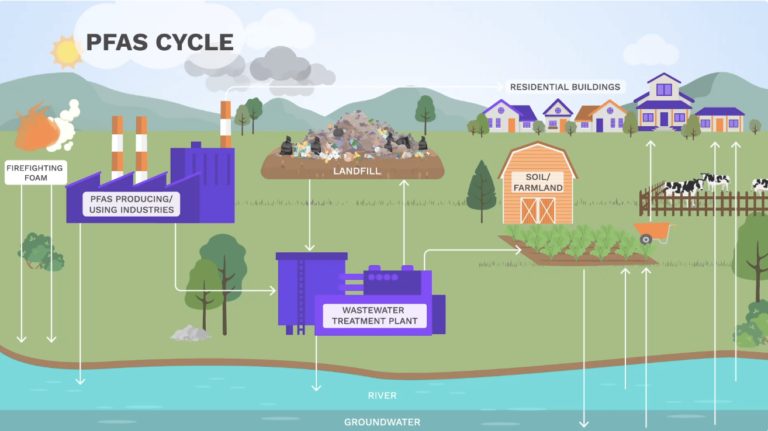
The primary risk is no longer confined to consumer products, but to systemic exposure through drinking water and food systems. This has been linked to increased cancer risk, higher cholesterol, and reduced fertility, while ecosystem exposure is associated with disrupted reproduction, immune suppression, and long-term biodiversity impacts.
What is shifting is not the science, but the response. In the UK, the government has released its first national plan to address PFAS, recognising their long-term risk despite currently safe levels. Across Europe, regulators are moving towards a broad phase-out, with estimated costs of PFAS pollution reaching €440 billion by 2050.
PFAS is no longer just an environmental concern. It is becoming a regulatory and economic constraint, creating demand for scalable solutions.
Recent articles on the topic:
The Guardian: Toxic Pfas residue identified on 37% of California produce, new analysis finds
The Company
One company building into this shift is Puraffinity, a London-based Imperial College spin-out focused on removing PFAS from drinking water.
The scale of the problem is significant. Global PFAS-related costs are estimated in the trillions, with water utilities alone expected to spend over $13 billion by 2030 on treatment and remediation. As regulations tighten, demand for effective and scalable solutions is accelerating.

Puraffinity’s approach centres on a PFAS-specific adsorbent material, designed to selectively capture both short and long-chain contaminants. Unlike traditional media such as activated carbon or ion exchange, which are adapted from broader filtration use cases, the material is engineered specifically for PFAS, enabling faster removal and more efficient treatment. Existing treatment methods can be energy-intensive or inefficient at low concentrations. Puraffinity’s technology aims to deliver more compact and cost-efficient water treatment across municipal and industrial use cases.
The question is whether this approach can move from promising material science to reliable, large-scale deployment.
Website: https://www.puraffinity.com/
Where Existing Solutions Fall Short
The problem is not that solutions don’t exist.
The PFAS remediation market is dominated by established players such as Veolia, Evoqua, Calgon Carbon, and Purolite, deploying a relatively standardised set of technologies including granular activated carbon (GAC), ion exchange resins, and membrane filtration. These systems were not designed specifically for PFAS, but adapted from broader water treatment applications.
Most existing approaches rely on separation rather than destruction, transferring PFAS into secondary waste streams that require incineration, transport, or further treatment. The chemicals are not removed, only displaced, often extending user liability rather than resolving it.
At the same time, performance is highly dependent on site-specific conditions, from water chemistry to organic content, requiring tailored, multi-stage systems that are complex, costly, and difficult to scale. These challenges are amplified when dealing with short-chain PFAS and low concentration contaminants, where existing technologies struggle to maintain efficiency.
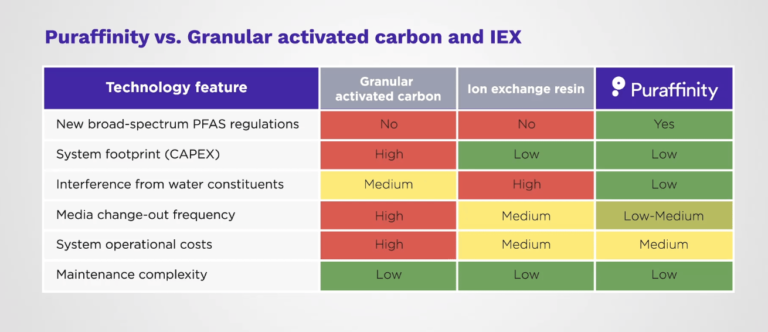
What emerges is not a lack of solutions, but a mismatch between what current systems are designed to do and what the problem now demands. The industry remains reliant on adapted legacy technologies that are operationally intensive, economically inefficient, and unable to fully eliminate PFAS contamination.
How This Could Work
If Puraffinity works, it is not because it replaces the system, but because it fits into it.
PFAS treatment is built around existing infrastructure and suppliers, so technologies that integrate easily have a clear advantage. Puraffinity’s media is designed to slot into these workflows, replacing or complementing materials like activated carbon or ion exchange. As a consumable, it would be replaced regularly, with value coming from improved efficiency and lower operating costs. A key advantage is speed. By removing PFAS more quickly, the system requires less material and a smaller footprint, reducing overall cost.
Early pilots suggest this is not just theoretical. In real-world conditions, the media has demonstrated consistent PFAS removal at low concentrations, alongside reductions in material volume, waste, and system footprint.
The appeal is leverage. A better material, deployed within existing systems, can scale without requiring new infrastructure.
The question is whether it can scale in practice. Water treatment is a conservative, trust-driven market dominated by incumbents who control distribution and customer relationships. Without proven deployments and integration into these channels, even strong performance may not translate into adoption.
If Puraffinity can bridge that gap, it positions itself as a high-impact upgrade in a growing, regulation-driven market. If not, it risks remaining a promising material without commercial traction. The most likely success case is integration, rather than disruption, with incumbents as natural acquirers.
What could go wrong
The main risk is no longer whether the technology works, but whether it can scale. While pilots show strong performance, including consistent PFAS removal under real-world conditions and continuous operation, moving from controlled deployments to widespread industrial adoption remains a significant step.
Adoption is the second challenge. Water treatment is a conservative, trust-driven market, where utilities rely on proven suppliers, certifications, and long-term performance data. Despite promising case studies, Puraffinity still lacks broad commercial deployment and established distribution channels, which can slow uptake regardless of technical advantages.
Finally, there is a risk that the solution is less frictionless than it appears. While the technology is positioned as a drop-in upgrade, real-world performance still depends on system integration, operating conditions, and customer willingness to switch from established solutions. If this introduces additional complexity, the advantage of improved performance may not be enough to drive adoption.
Verdeindex View
Puraffinity is targeting a problem that is becoming increasingly unavoidable. As regulation tightens, demand for scalable PFAS treatment is likely to accelerate, creating a durable market opportunity. Its PFAS-specific approach offers a differentiated solution that can integrate into existing systems, with a natural pathway toward partnership or acquisition by incumbents.
The team is a key strength. CEO Vincent Caillaud, formerly CEO of Veolia Water Technologies, brings over two decades of experience in the water industry and deep familiarity with the customers and infrastructure the company needs to penetrate. CTO Jessica Midlemiss complements this with a background in materials science and product development at companies such as Dyson and Sartorius, with experience scaling complex engineering systems into manufacturable products.

The team is strong, but the question is execution. Success will depend less on the technology itself and more on the company’s ability to scale and gain adoption in a conservative, incumbent-led market.