

Introduction:
In this edition, we spotlight Future Cleantech Architects, a non-profit shaping bold climate innovation, and Energy Dome, a start-up redefining energy storage. We also confront the growing challenge of how climate change is reshaping the housing market, driving falling prices and rising risks. Yet, we close on a note of optimism, fuelled by the next generation’s unwavering fight for a sustainable future
Oscar Petterson Fuentes
Non-profit: Future Cleantech Architects
Think tanks provide valuable research to propel innovation and creative thinking across various industries and shape public policy and debate. This edition’s non-profit of the week is Future Cleantech Architects (FCA), a climate innovation think tank founded by CEO Peter Schniering that aims to accelerate decarbonization in hard-to-abate sectors such as cement, shipping, and aviation.

The basis of the company is innovation, and as 50% of the technological innovations required to reach net zero by 2050 still need to be developed, their work in policy advocacy and R&D has the potential to drive significant change. FCA has established itself as a leading think tank in sustainable policy development working closely with the EU. They have published a report outlining 5 priority action areas, including the essential components for a decarbonised, sustainable industrial agenda. These 5 priority areas include a ‘2027 research and innovation agenda’ that aims to nurture EU competitiveness to develop cleantech solutions from the very first stage to deployment. Moreover, the report highlights the importance of reducing Europe’s energy dependence on natural gas by switching to low-carbon alternatives, decarbonising industry and outlining concrete steps on how the EU can secure longer-term funding for cleantech manufacturing and infrastructure. This report is the basis of their work in advising legislation and policy-making, which is facilitated by their presence in Germany and Brussels.

In addition to policy making, FCA conducts research in sectors such as cement, aviation, shipping and energy- all industries that require innovation to decarbonise. They publish fact sheets and reports to highlight challenges and recommendations within each of these sectors, hoping to raise awareness but also to support the industries in their quest for sustainability. FCA also values events and talks to spread its research and ideas across the industry. In 2024, FCA hosted an event on thermal energy storage in Washington, organised the Future Cleantech Festival 2024, and attended COP29 in Baku, conducting a talk on leveraging public-private synergies to accelerate the global energy transition. FCA is a non-profit think tank that uses funding to accelerate progress towards net-zero but also leverage their unique position as an established think tank to promote dialogue through various mediums, which all contributes greatly to not only Europe’s sustainability but sustainability on a global scale.
Tech start-up: Energy Dome
This edition’s tech start-up is Energy Dome, founded by CEO Claudio Spadacini. The company is striving to unlock the full potential of the clean energy transition by solving the issue of long-term storage. Renewable energy critics will argue, ‘what happens when the sun doesn’t shine or the wind doesn’t blow?’ and this does hold some truth if we do not solve the challenge of storing large amounts of energy efficiently and cost-effectively. Energy Dome has developed a patented CO2 battery characterised by a design that is efficient, cost-effective and scalable.
The CO2 battery is a closed thermodynamic transformation which involves the manipulation of CO2 from aqueous to gaseous states. The process involves charging by drawing carbon dioxide from a ‘Dome’ gasholder, storing it under pressure, and then dispatching it by evaporating and expanding the gas through a turbine back into the gasholder when the energy is needed. The benefits of this technology include a long lifetime, over 30 years, which is over double that of a standard lithium ion battery plant and does not require rare earth metals, the supply of which are becoming increasingly constrained. Moreover, a unique feature of this system is that every component within this technology is off-the-shelf, creating a plug-and-play system that can be integrated into any geographic region. This enables scalability, which is paramount as the energy transition is global and requires global solutions.
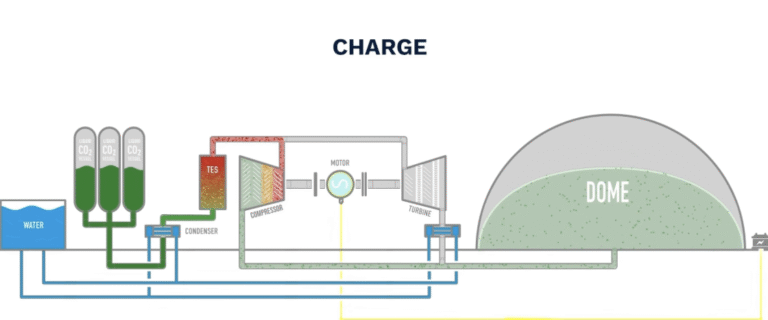
Energy Dome’s product is the CO2 battery plants, in which they help to advance permitting, often a lengthy process in energy projects, and, with an experienced project team, help build and make the plant operational. Energy Dome goes even further to provide energy storage as a service, maintaining, operating and even funding energy storage systems. This requires no capital expenditure from utility companies, who simply enter into power purchase agreements. This allows companies to decarbonise without the hassle of operating these systems. Moreover, Energy Dome is expanding, with large investments from Barclays and recent collaborations with firms such as NTPC Ltd., India’s largest integrated power generation company. Energy Dome’s unique technology showcases the importance of innovation as one of the many tools to achieve progress towards decarbonization.
Website: https://energydome.com/
Challenge: How Climate Change is Shaking Up the Housing Market: Falling Prices & Rising Risks
I have previously written about the challenges the insurance industry faces when it comes to climate change, where many of the world’s largest insurance firms see climate change as the biggest risk to their operations. However, this risk will also have a tremendous impact on consumers, and today’s challenge will explore the impact of extreme weather on the property market.
Already, across the world, we are seeing spikes in homeowner insurance premiums as a result of the increased probability of extreme weather. The price increase disproportionately impacts low-income households, which has led a growing number of people to forgo insurance altogether, placing them in an exposed financial situation. Insurance is a key criteria to take out and refinance mortgages, so if homes are uninsurable or people can’t afford to buy insurance, people will be unable to finance properties, and property prices will subsequently tumble. For the individual, wealth is usually tied to property, so individual wealth is at the mercy of these falling property prices.
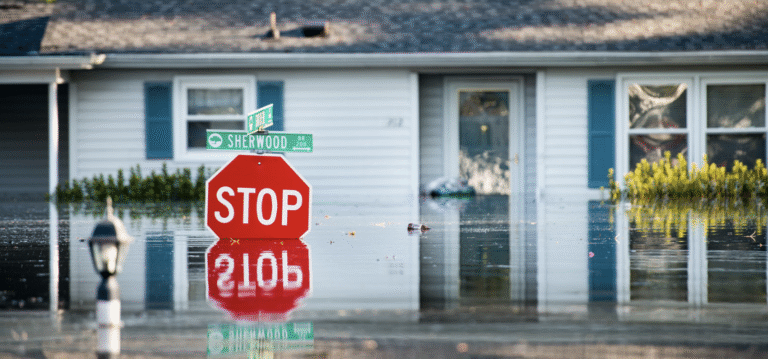
Mortgages are essentially a long-term investment in the property, so if its value declines, this will also leave banks exposed. People unable to sell their property or refinance mortgages will lead to mortgage defaults, spelling out losses for banks and therefore low investment and lending, a recipe for low economic growth, which will exacerbate financial predicaments beyond the individual.
In some well-documented cases, especially in California and Florida, insurers have left states and geographic regions altogether. With insurers being unable to operate in certain locations, the state has to step in, but to what extent they can afford this must be questioned. If costs become too high, state insurance programs will likely fail, and as people leave climate-risk areas and sell their properties, tax bases and municipal budgets shrink, devastating their ability to mitigate climate change.
Despite this, governments around the world are building properties in high-risk areas to keep up with housing demands, so identifying these challenges is a must if we want to prevent the above-mentioned impacts. Already, banks, insurers and consumers are building their awareness around the impacts of climate change on their properties, which should propel local governments to increase their climate mitigation efforts to restore confidence and prevent the serious economic consequences of inaction.
Articles on the topic:
The Guardian: Uninsurable and unaffordable: climate change and the rising cost of housing
The Financial Times: Climate risk is US housing market’s neighbour from hell
Bloomberg: The $2 Trillion Housing Market Nightmare Is Getting Even Worse
Hope: Fuelled by Hope: The Next Generation’s Fight for a Sustainable Future
The younger generation is facing a worrying fact. For the first time in human history, we cannot confidently say that the world we are leaving to the next generations will be a better one. A troubling thought, but realistic. Geopolitics is becoming more unstable by the day, technology is advancing towards the dangerous unknown, and the life-saving planetary boundaries that have kept the planet stable for over 10,000 years are being gradually exceeded.
The younger generation is well aware of how mismanagement and inaction will impact them. I am part of this generation, and we understand that we cannot trust some of those currently in power, those making decisions for our future, to safeguard our way of life. In recent years, this has been a growing trend within the younger generation, with a Lancet Planetary Health report finding that 85% of young people feel worried about climate change. However, the younger generation has in unison made its presence abundantly clear, from activists such as Greta Tunberg voicing her anger on some of the world’s most important stages, to the countless civil society groups, led by the youth who are all joined by the message: ‘we are watching you’. Dedicating their efforts to hold polluting industries and negligent policy-making to account.
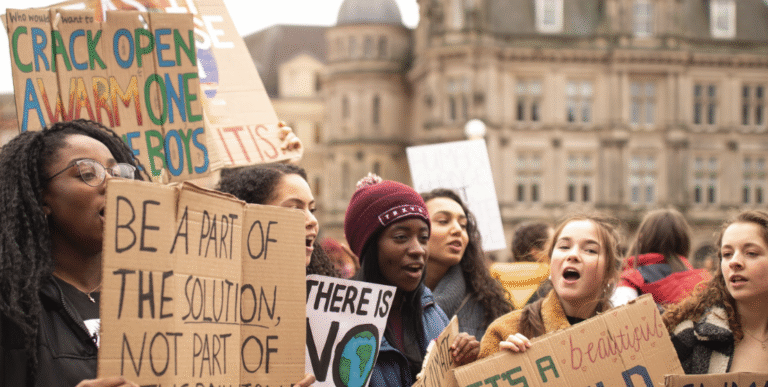
The digitally native generation is also using social media, AI and technology to transform how movements and messages mobilise. These online tactics are much more affordable than traditional in-person events and have the potential to impact young people across the world. Furthermore, the youth have access to countless scientific papers and studies, so attempting to deflect the truth, like the oil and gas industry did in the 1980s, will no longer work. The younger generation is in a great position to propel sustainability. No generation has ever been so worried about climate change, and it is without a doubt that this worry will translate into action. I am hopeful that the younger generation, having grown up with the impacts of climate change, will not underestimate its gravity as an issue that transcends just thinking about the environment to also understand its impacts on our economies, politics and way of life. To realise this, we cannot just wait for the youth to get into power years down the line; we must also, alongside current youth-led efforts, support allies in the older generation, of which there are many, who can lay the groundwork and build a foundation to support a sustainable future.
Image of the week:
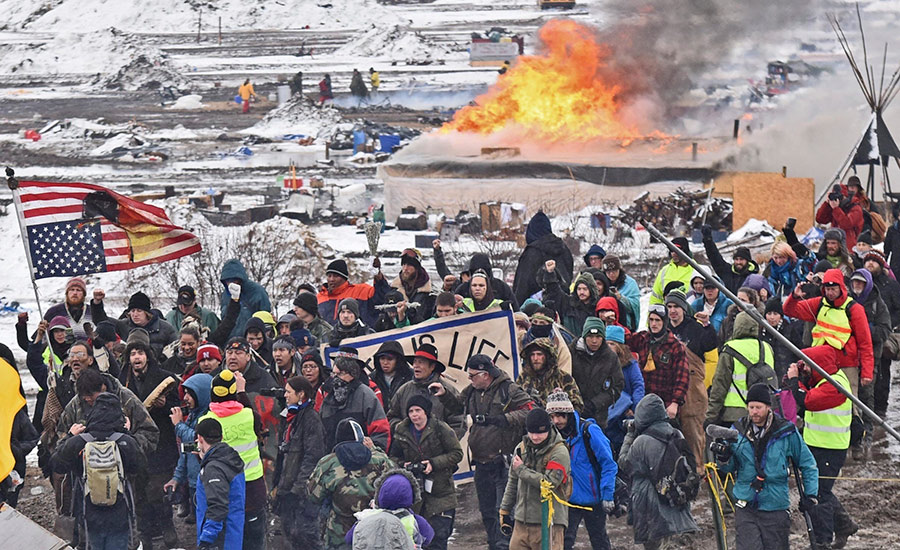
This week’s image of the week is a picture from the Dakota Access Pipeline protests from 2016/17. These protests stemmed from a justice-centred perspective where the Dakota Access Oil Pipeline, upstream of the Standing Rock Sioux Tribe’s reservation, threatened to contaminate their water supply, which is paramount to their way of life.
However, the reason I have included this picture is as a result of a recent ruling from a North Dakota jury on the 19th of March, which found that Greenpeace was guilty of defamation amongst other claims and ordered to pay more than $650 million to Energy Transfer, the utility company that owns the pipeline. This is an amount that would cripple Greenpeace’s operations.
The case was shrouded in secrecy with no court reporters and still no public transcript of the case. Those who monitored the proceedings, including the legendary US human rights attorney Marty Garbus, who represented Nelson Mandela, said it was the most unfair trial he had ever witnessed. This says something and Steven Donziger from the Guardian outlined that 7 out of 11 people in the jury had ties to the fossil fuel industry, there were no people of color or native american origin on the jury, and Greenpeace were blamed for the entire protest and all the damages despite only playing a minor role.
The warped nature of this trial will hopefully mean that Greenpeace will not have to pay up and a second proceeding, a lawsuit this time against Energy Transfer, in the Netherlands, will be held, and it may be Energy Transfer who will be ordered to pay substantial sums to Greenpeace. Whatever the outcome, this verdict marks troubling implications for civil society and highlights the Trump administration’s broader attacks on civil society, which is a tactic being echoed by right-wing and authoritarian leaders across the world.
Articles you may have missed:
1.How incumbents can succeed in climate-driven growth investments
2.Average person will be 40% poorer if world warms by 4C, new research shows
3. Reconsidering Sovereignty Amid the Climate Crisis
4. Underwater farms: a new hope for combating climate change?
5. Climate change isn’t fair but Tony Juniper’s new book explains how a green transition could be ‘just’
Thank you for reading!
To sign up to the newsletter, go to www.verdeindex.com
Or follow Verdeindex on LinkedIn at: https://www.linkedin.com/company/verdeindex/