

Introduction:
In a world grappling with climate change and shrinking civic spaces, this edition explores resilience and innovation across sectors. I spotlight 350.org’s global grassroots activism, NyoBolt’s breakthrough in sustainable battery technology, and the urgent challenge of protest being increasingly policed to extinction. Yet, just as resistance evolves, nature offers its own inspiration, with the discovery of heat-resistant algae providing new hope for our oceans. Together, these stories show that even under pressure, new solutions and movements continue to rise. I hope you enjoy reading.
Oscar Petterson Fuentes
Non-profit: 350.org
This edition’s non-profit is 350.org, a grassroots climate movement that campaigns to reduce carbon emissions by stopping fossil fuels and simultaneously empowering renewable energy projects. The organisation spans over 188 countries, making it one of the most influential climate organisations on the planet. Executive director Anne Jellema and manager director Olivia Langhoff leveraged their extensive knowledge in community organisation and activism to build a movement that delivers impactful change.
350.org operates under a clear pathway of stopping fossil fuels, financing climate action and enabling renewable energy projects from the ground up. To achieve these aims, 350.org emphasises the need to build a collective network of activism that coordinates large-scale actions and campaigns. They realise this aim by funding and connecting local activist groups worldwide who are all joined by the same goal of ceasing our dependence on fossil fuels. 350.org is adamant that we must keep fossil fuels in the ground, and through campaigns and divestment movements that target universities, cities and pension funds, they have successfully delayed and prevented new fossil fuel infrastructures, including the opposition to the Canadian-US Keystone oil pipeline, which was terminated by Joe Biden in 2021

In addition to their fierce opposition to the oil and gas industry, they also provide a solution, which is crucial in any sustainability-oriented movement. Their solution is to mobilise groups of individuals to understand the possibilities of renewable energy projects through education, mobilising policy makers and importantly, financial support. It is clear to see why 350.org places such importance on renewable energy projects, as renewable forms of energy strip away the power structures reinforced by the centralised energy systems of the oil and gas industry and instead offer the possibility of decentralising our energy systems and bringing power and control back to communities. This can provide numerous benefits, including development that maximises community benefit as opposed to corporation and individual profit maximisation and cost stability due to strengthened energy security. 350.org are an influential organisation that focuses on the energy transition and what I admire about this organisation is that they do not solely focus on campaigning against the issues we face, but they also campaign for and fund the solutions, which helps give communities an alternative and therefore the ability to reduce their dependence on fossil fuels.
Website: https://350.org/
Tech start-up: Nyobolt
This edition’s tech start-up is Nyobolt, a UK-based company specialising in developing and commercialising ultra-fast and high-power battery solutions. Founded by Clare Grey and Sai Shivareddy, Nyobolt has presented itself as a highly innovative solution to the battery crisis; a crisis that has become increasingly persistent as the world accelerates towards electrification. However, one of the barriers to real growth in the EV and robotics industry is an inadequate fast-charging infrastructure, which makes EVs less attractive and can increase costs in robotics. Nyobolt has developed a battery and charging solution which essentially delivers higher power in less time.
Nyobolt’s proprietary battery cells have the potential to be charged from 0% to 100% in as little as 5 minutes, which is a significant improvement over conventional lithium-ion batteries. The technology includes a variety of advanced materials such as tungsten, novel carbon and metal oxide composites that facilitate rapid electron transfer and therefore fast-charging. Nyobolt’s expertise in material science and cell chemistry places them in a unique position to combine the most innovative scientific solutions with real-world issues to propel electrification across a variety of sectors. In the EV industry, Nyobolt showcased a prototype EV last summer, which could charge from 10% to 80% in under five minutes, ensuring that the vehicle’s battery was lighter. Five minutes is incredibly fast when we put it into context against a Tesla supercharger, which can charge the same amount in 15-20 minutes. Although the technology is still in its early stages, the successful deployment of this battery across the EV industry could unlock petrol-style recharge times (the average stop at a petrol station), which will reduce ‘charge anxiety’ for consumers and likely propel the industry to new heights.

Nyobolt’s ventures in the EV industry are still in their early stages, but this hasn’t prevented serious revenue growth, over $9 million in 2024, and a recent $30 million investment round. The source of this growth has come in the form of fast-charging for heavy-duty machinery and, importantly, the use of their battery cells to meet the incredibly high demand for power from AI automation, AI warehouses and GPU-powered data centres, which all require significant energy consumption. Nybolts’ technology provides significant power while using fewer resources than lithium batteries. This improves the efficiency and sustainability of AI infrastructures, which is becoming increasingly important as a result of their unprecedented growth.
Ultimately, Nyobolt is an exciting company whose success in the robotics and AI-infrastructure industries provides a solid base to maintain revenue growth, attract investment and continue their expansion towards key industries such as EVs, all while improving the efficiency and sustainability of the electrification process.
Website: https://nyobolt.com/
Challenge: Protest Is Being Policed to Extinction but New Movements Are Rising
Protests are a pillar of democracy and are central to the climate movement. However, increases in police power in the UK have made” intentionally or recklessly causing public nuisance” a statutory offence. In addition to this, judges have blocked the right for protestors to argue the case for ‘lawful excuse’, which previously allowed protestors to argue to the jury that their actions were justified by the bigger threat posed by climate change. Such responses to protests, not only directed towards the climate movement, have become a growing trend across the globe, and questions therefore have to be asked as to the possible implications on protest strategies.
One of the key organisations behind the increased policing powers was Just Stop Oil. A group whose protests were characterised by causing the maximum disruption, while adhering to non-violent forms of protest and the idea of accountability. This idea of accountability essentially stated that protestors would disrupt until they were arrested, however, these new policing powers and courtroom changes have undermined the idea of accountability as protestors can be arrested with ease and trials no longer take into account the motivations behind why the protests caused the disruption, leading to high conviction rates. As a result, protestors are no longer hanging around after causing disruption and this has led to groups forming, such as Shut the System, that have carried out a series of criminal attacks, such as smashing windows on the offices of insurance and finance companies and even targeting fibre optic communication tables. This goes to show that the changing narratives towards protestors, partly fueled by their unpopularity, are pushing groups to the extremes where protestors are no longer peaceful or accountable.

This is worrying, yet we have to understand that the climate movement is entwined with ideas of non-violence and these principles will likely continue and may limit the consequences of underground climate activism. Moreover, the forms of protest that groups such as Just Stop Oil deployed were highly unpopular, and Rupert Read, a spokesperson for Extinction Rebellion, puts it well when he says:
- “[Just Stop Oil] generated a lot of headlines, but sometimes people give you coverage precisely because they think that coverage will be bad for you and your cause.”
The protests alienated a large proportion of the public from the climate movement, and a change in strategy will likely be welcomed. With that said, protests are changing, and how the climate movement reacts to changing laws on protest will be pivotal in garnering public support for climate-related causes, which fundamentally should be the aim of protests, as public opinion is a significant driver of policy change.
BBC: How Just Stop Oil was policed to extinction
Hope: Heat-Resistant Corals Offer New Hope for Ocean Survival
Corals are some of the most impacted marine organisms by our changing climate. Only recently has the greatest coral bleaching event on record taken place, with a staggering 80% of the planet’s reefs being impacted. Coral bleaching is a process where corals lose their vibrant colours and turn white due to stress, typically caused by climate change-related impacts such as elevated water temperatures and acidification from increasing CO2 levels. With action on emissions still stagnating and the world moving towards even warmer temperatures, the future for corals looks bleak. However, OCEAN 1, a UNESCO project led by photographer Alexis Rosenfeld alongside researcher and scientist Laetitia Hédouin, has discovered what they deem a ‘biological treasure chest’ in a lagoon off the small island of French Polynesia.
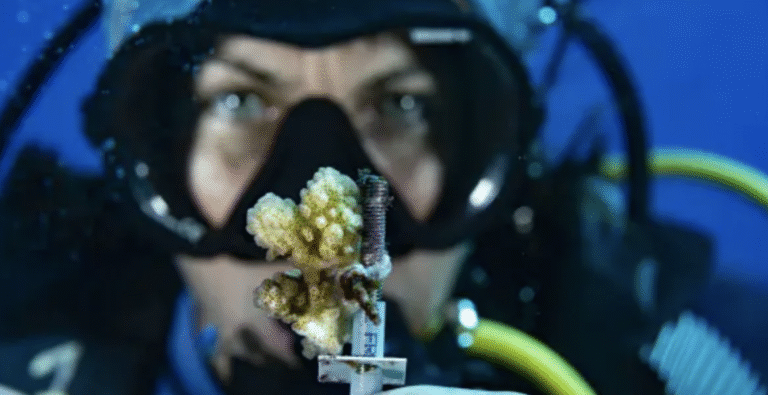
This lagoon experiences abnormally warm temperatures, even compared to the surrounding ocean, so when an extreme ocean heating event occurred, it was expected that the corals would bleach. However, scientists discovered that dozens of species of coral, which were usually hardest hit by increases in temperature, were thriving in these unstable environments. Hédouin believes that the corals have developed a biological mechanism that helps them survive, and this could be a highly significant discovery.
If these heat-resistant corals can grow and reproduce in other areas across the world, it would be an incredible source of hope for coral conservation. With strategic interventions, via a process called assisted migration, heat-resistant species could repopulate damaged coral reefs and improve resilience within these vulnerable ecosystems. Alexis Rosenfeld, a key actor in these discoveries, is documenting these findings through films and photographs, which he hopes will help spread awareness to local conservation groups and policymakers across the world to help protect marine ecosystems from the impacts of climate change.
UNESCO: Heat-resistant ‘super corals’: a source of hope for the future of coral reefs?
ABC news: Thermoresistant ‘super corals’ offer hope amid climate change: Scientists
Image of the week:

This edition’s image of the week comes from South Africa’s Wildlife Forensic Academy, a state-of-the-art training centre launched in May that hopes to bolster the global fight against wildlife crime by equipping environmental law enforcers with the skills they need to collect evidence and secure convictions in court.
The academy, which is located on a wildlife reserve an hour’s drive north of Cape Town, hopes to educate and inspire its students using a series of realistic wildlife crime scenarios. Besides the stuffed Giraffe seen in the image below, there is a rhino, a lion, a plant-poaching setup, a poacher’s house and truck and an inflatable boat of the type used by poachers.
The academy aims to train its students in every step of the process, from the discovery of a crime scene to the conviction of the perpetrator. Among its facilities is a laboratory for the chemical analysis of evidence and a courtroom where students can get a feel for what it is like to present evidence at a trial and to undergo cross-examination.
The academy provides much-needed education, which is pivotal in tackling the issue of poaching. Rangers who might be experts in locating and understanding these animals are usually not equipped with the knowledge to deal with poaching crime scenes and their nuances, making it possible for poachers to get away with murder.
Articles you may have missed:
Thank you for reading!
To sign up to the newsletter, go to www.verdeindex.com
Or follow Verdeindex on LinkedIn at: https://www.linkedin.com/company/verdeindex/